Fishing Friday: Expert Angler Shawn Kimbro on Got Bait?
When Got Bait? called, Shawn Kimbro jumped at the chance to be the fishing show's guest angler.
When Lenny Rudow asked me to join him and his sons David and Max as they filmed Got Bait? The Search for Stripers, I was pumped about the invitation for several reasons, not the least of which is that I would get to fish with Lenny. He and I move around in similar circles, but we’ve only had one brief opportunity to fish together. I’m a big fan of Lenny’s informative books, especially his iconic and aptly titled Rudow’s Guide To Fishing The Chesapeake. Additionally, I’ve heard great things about Max and David, so this would be my opportunity to finally meet them. To make the invitation even better, my friend Gary Reich would be joining us as assistant producer.

Shawn Kimbro is a well-known angler on Chesapeake Bay.
On the morning of the filming, I launched my 27′ Judge Center Console Thunder Road at Matapeake and zoomed by Thomas Point Light to our predetermined rendezvous point outside the West River. The plan was to use my boat as the chase boat for filming, and Lenny’s PowerCat for fishing. As I jumped on board with Lenny and handed the boat keys over to Gary, I pointed out that the weather was great and all signs pointed toward a successful fishing day.
(That might have been what jinxed us.)
The premise of Got Bait? is that Max and David are paired against Lenny and a guest angler, in this case me, with one team using bait and the other using artificial lures. On this trip, the boys would be live lining with Norfolk spot while Lenny and I threw soft plastic baits, specifically Bass Kandy Delights (BKDs) or possibly topwater plugs.
I don’t do much live lining. My opinion of live lining with spot is that it is too efficient for my style of striper fishing. Spot are nicknamed “rockfish candy” for good reason. A live spot dropped into a school of feeding stripers has an average life expectancy of zero point five seconds. Not only do stripers love them, but they gobble them up so fast that they usually swallow them whole. Since that results in deep-hooking, spot fishing isn’t a good practice for those who want to catch and release. I’m a lot more interested in the experience of fishing than I am in putting meat in the boat, so I’d much rather try to outsmart the fish with lures.
That said, I consider live lining to be the most potent fish-catching technique. If your goal is to go out, get your limit, and go home, then by all means, go live lining.
Despite that deadly efficiency, a good artificial-lure fisherman can usually compete with live lining, and we usually don’t kill fish. I thought the challenge would be interesting, especially since extra points would be awarded for bigger fish.
I’ll say right up front that I’ve rarely seen two young men more enthusiastic about fishing than Max and David. Those guys were raring to go. There are adults who think we should take it easy on kids, you know, break them in slowly, be careful not to damage their fragile young egos, pull a few punches here and there. I’m not one of those people. Life is hard boys, get used to it. I was looking forward to kicking their skinny little bait-sniffing butts.
Anticipation was high as we showed up at the top-secret spot where Lenny wanted to fish. It was a series of underwater rock piles in relatively shallow water. All the conditions seemed right; the wind was light, the fishfinder showed plenty of bait, and we had a steady incoming current. As is typical in a situation like that, the first lure out of my box was a topwater plug. Since it was relatively calm, I went with a Lonely Angler Glow Zipster. For the past couple of years this has been one of the hottest surface lures on the Chesapeake Bay when it is fished with its intended walk-the-dog style.
Why the fish wouldn’t hit it that morning, I don’t know. The boys drifted their live spot right over the rocks with no strikes. We worked the area for about an hour, then called it a bust and moved on.
We all know that some fishing days are better than others, but I thought surely we could find a bite or two on a summer weekday on the Chesapeake Bay. I suggested a cruise down toward Poplar Island. I’d fished there the day before and I knew there was a lot of fish in that area, including some pretty big ones. We zoomed past Bloody Point Lighthouse and came off plane near Kent Point so I could scan the horizon with my binoculars for birds. I didn’t see any, so we moved south and East toward Poplar Narrows. By this time, the tide was starting to slack, so we decided to check out some underwater ledges in an area that normally gets a lot of current. We started zig-zagging up and down the ledge, checking on the fish finder for marks.
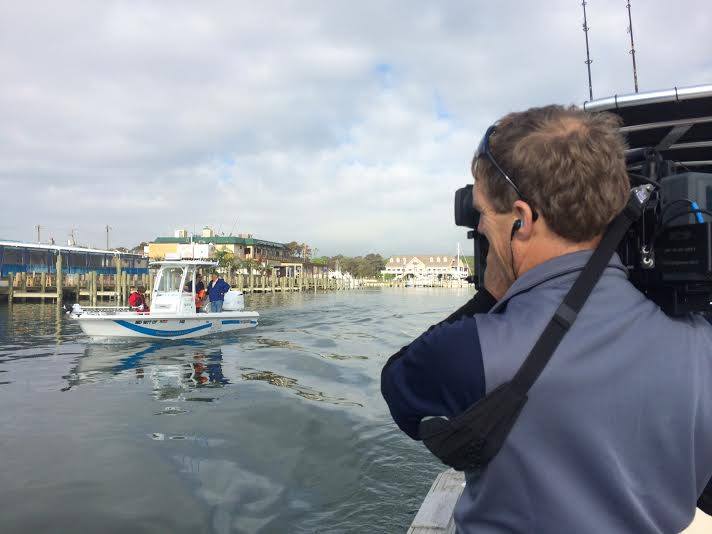
This is a good time to point out that a chase boat can be a pain in the rear when you’re trying to fish. One of my top priorities for light-tackle casting is to be as stealthy as possible. That’s hard to do when there’s another boat motoring all around looking for good camera angles. But you have two boats looking for fish instead of one, and Gary was the first to spot the fish. He called in on the VHF radio to say that he had very good marks about a hundred yards to our west.
Lenny repositioned our boat and we both hooked up on our first cast.
Finally!
To find out how the rest of the day went, read Got Bait? The Rest of the Story.
Watch the latest episode of Got Bait?